L.A.B. Golf Brand Spotlight: From a Trailer in Oregon to a Nine-Figure Putter Empire
On a Sunday afternoon in June 2025, J.J. Spaun stood over a 64-foot putt on the 18th green at Oakmont. US Open on the line. Rain delays, dramatic comebacks, the whole package. He drained it. Champion.
The putter in his hands was a L.A.B. Golf.
A month later, a private equity firm bought the company in a nine-figure deal. Seven years after a former music industry executive bought a failing Oregon putter company out of a trailer with two employees, L.A.B. Golf had become one of the most disruptive equipment stories in modern golf. It outgrew Scotty Cameron's enthusiast cachet. It outpaced Bettinardi's craftsmanship niche. It put a putter that looked like "a satellite dish" or "a toilet seat" — early reviewers' actual words — into the bags of Adam Scott, Will Zalatoris, Lucas Glover, Phil Mickelson, Charles Howell III, and the US Open champion.
This is the L.A.B. Golf story — how it started, why it actually works, every current putter in the lineup, and what to know if you're shopping one on the used market. The brand has shaken up the most stagnant equipment category in golf. Worth understanding why.
Quick Answer: L.A.B. Golf is an American putter manufacturer founded in 2018 by Sam Hahn after he acquired the assets of the failing Directed Force company. The name stands for "Lie Angle Balance," a patented technology invented by Bill Presse IV in 2014 that eliminates torque during the putting stroke — allowing the putter face to naturally stay square to the arc without manipulation. L.A.B. has experienced 18,000%+ growth since 2018, attracted tour staffers Adam Scott, Will Zalatoris, Lucas Glover, Phil Mickelson, and 2025 US Open winner J.J. Spaun, and sold a majority stake to private equity firm L Catterton in July 2025 in a major nine-figure acquisition. The current lineup includes the DF 2.1, DF3, MEZZ.1, MEZZ.1 MAX, LINK.1, OZ.1, and OZ.1i.
What Is Lie Angle Balance? The Technology Explained
Every traditional putter on the market has the same fundamental problem. When you swing it, the head wants to twist.
This twisting happens because the center of mass of the putter head sits below the shaft axis. As you swing back and through, gravity and inertia work on that offset mass and try to rotate the face open on the backswing and closed on the follow-through. Heel-toe weighted putters (Anser, Newport) reduce this twist somewhat. Face-balanced mallets reduce it further. But none of them eliminate it.
Bill Presse IV — a former mini-tour player turned club builder — figured out the math in 2014. He proved that with the correct combination of head shape, weight distribution, shaft attachment point, and lie angle, you could build a putter where the center of mass aligns with the shaft axis in a way that completely cancels the twisting moment. The result is what Presse called a "Lie Angle Balanced" putter — one that doesn't want to twist at all.
The Revealer: How Presse Proved His Point
Presse built a tool he called The Revealer — a fixture that holds any putter in place and demonstrates how it wants to twist during a stroke. Set a traditional putter on The Revealer and watch the head wobble open and closed during a simulated swing. Set a L.A.B. putter on it and watch the head stay completely still. The demonstration is striking enough that early skeptics — including the man who would eventually buy the company — became immediate believers after seeing it.
The Revealer is still on L.A.B.'s website and in their fitting centers. It's the closest thing to a smoking gun in equipment marketing — direct visual evidence of the technology working as advertised.
The motto L.A.B. uses captures it perfectly: "Don't KEEP the face square. LET the face stay square." Traditional putters require you to actively manage face angle through the stroke. L.A.B. putters do it for you. That single shift in player workload — from active management to passive trust — is the foundation of the brand's entire value proposition.
For the historical contrast on the original face-balanced putter design, see our Ping Anser putter evolution piece.
The Improbable Founding Story
L.A.B. Golf's actual history is messier and more interesting than most equipment company origin stories.
2014-2017 — Bill Presse's Garage Years
Bill Presse spent years experimenting with putter geometry in his shop, eventually patenting Lie Angle Balance and creating his first commercial product: a putter called the Directed Force. The head shape was unconventional — large, half-moon, sometimes described as resembling a satellite dish or a branding iron — and the original branding was equally unconventional. Sales were slow. The company was small. Most golfers who encountered the Directed Force walked away amused, confused, or both.
By 2017, Presse was running the company out of a trailer in Oregon, building putters with two employees, and selling them out of the trunk of his car to anyone who would listen. The technology was real. The business was failing.
2018 — Sam Hahn Buys the Company
Sam Hahn was a wealthy businessman from the Oregon music and entertainment industry — a self-described "putter psycho" who would spend hours on practice greens experimenting with different putters. A friend tipped him off about the Directed Force. Hahn ordered one. Within six weeks, his handicap reportedly dropped from 1 to +3.
When his putter broke, Hahn sent it to Presse for repair. The two started talking. Hahn realized Presse had built something genuinely important but had no business engine behind it. He pooled funds, bought the assets of the failing Directed Force company, and rebranded it as L.A.B. Golf (Lie. Angle. Balance.) in 2018. Presse went back to focusing on technology and club building. Hahn took over the branding, manufacturing, operations, and online presence.
2019 — Adam Scott at the Masters
The first major break came at the 2019 Masters. Adam Scott — the 2013 Masters champion, one of the most respected putters in modern golf — debuted a L.A.B. putter in the most-watched tournament of the year. The story behind that switch is even better than the moment itself.
Scott had been visiting professional surfer Kelly Slater at Slater's home. Slater was using an early L.A.B. Directed Force putter on his backyard putting green and making everything in sight. Scott watched Slater for three days, asked questions, then got fit for his own L.A.B. within weeks. He's been gaming the brand ever since. That sequence — Kelly Slater introducing Adam Scott — is one of the better equipment chain-of-custody stories in modern golf.
2020-2021 — The YouTube Inflection
In 2020-2021, golf YouTubers Rick Shiels and Peter Finch posted reviews of the L.A.B. Directed Force. Both were positive. Sales tripled overnight. Matt Fisher (MrShortGame Golf) followed with his own review in June 2021. L.A.B. went from cult product to mainstream awareness without spending a dollar on traditional advertising. They didn't even need to touch the seven-figure funding round they raised between 2020 and 2021 — sales velocity made the capital unnecessary.
2023-2024 — Tour Validation
Lucas Glover ended 2023 by winning two consecutive PGA Tour events gaming a L.A.B. putter, including the Wyndham Championship and the FedEx St. Jude Championship. The wins resurrected Glover's career and turned L.A.B. into a serious tour player conversation. Will Zalatoris, Charles Howell III, Charl Schwartzel, and others followed. Phil Mickelson started rotating L.A.B. putters in and out of his bag depending on form. The brand sold approximately 130,000 units in 2024.
2025 — J.J. Spaun and the Major Acquisition
June 2025: J.J. Spaun drained a 64-foot putt on the 18th green at Oakmont to win the US Open. The putter was a L.A.B. Golf. Millions of viewers watched the brand validate itself in golf's highest-pressure moment. Sales exploded immediately.
July 2025: L Catterton — the private equity firm best known for backing brands like Peloton, Equinox, and Birkenstock — acquired a majority stake in L.A.B. Golf in a nine-figure deal that valued the company in the hundreds of millions. Both Presse and Hahn remained involved in the company. The trailer-to-empire arc was complete.
Current production runs out of a 64,000 square foot factory in Creswell, Oregon, with approximately 150-185 employees and growing. Each putter is still hand-built by craftsmen who account for the multiple variables required to achieve proper Lie Angle Balance — head design, length, lie angle, shaft, and grip — all dialed in to the individual fitting specs of the buyer.
The Current L.A.B. Lineup: Every Model Explained
L.A.B. now produces a range of putter models across distinct shapes and player preferences. Each one uses the same Lie Angle Balance technology — the difference is head shape, profile, weighting, and visual aesthetic.
| Model | Shape | Best For |
|---|---|---|
| DF 2.1 | Half-moon mid-mallet (original) | Players who want the iconic L.A.B. look |
| DF3 | Refined half-moon, modern updates | Updated DF aesthetic with current tech |
| MEZZ.1 | Conventional mid-mallet | Mainstream-look players new to L.A.B. |
| MEZZ.1 MAX | Larger mid-mallet, more forgiveness | Players wanting maximum stability |
| LINK.1 | Blade-style | Traditional players who hate mallet looks |
| OZ.1 | Half-moon solid-body (Adam Scott collab) | Players who want Adam Scott's design |
| OZ.1i | OZ.1 with refined topline / alignment | Updated OZ.1 with crisper alignment |
DF 2.1 and DF3 — The Originals
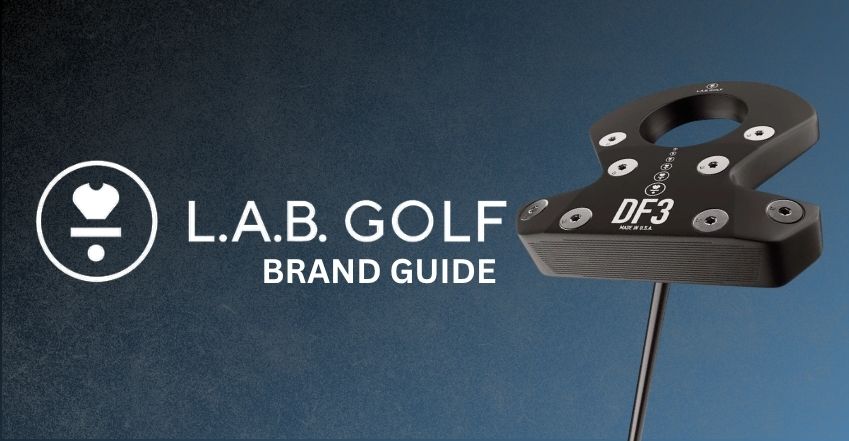
The DF (Directed Force) series carries the most iconic and most polarizing visual identity in modern golf. The half-moon head shape — large, distinctive, looking nothing like a traditional putter — is the design that earned the early "satellite dish" and "toilet seat" nicknames. It's also the design that's currently winning major championships.
The DF 2.1 is the modern refinement of the original Directed Force shape. The DF3 takes that even further with updated finishes and minor geometry refinements. If you're committing to L.A.B., the DF line is the purest expression of the brand. Best for: players who don't care what their putter looks like as long as it performs, and players drawn to the brand's distinctive identity.
MEZZ.1 and MEZZ.1 MAX — The Conventional Looks
Hahn and the L.A.B. team recognized early that the DF shape was a barrier to adoption for many traditional players. The MEZZ.1 (and larger MEZZ.1 MAX) solved that problem with a more conventional mid-mallet shape that delivers the same Lie Angle Balance technology in a head that doesn't draw stares at the club. The MEZZ.1 has eight weights on the bottom and two on the sides, giving fitters precision control to build the putter to the customer's exact lie angle and weight preference.
Best for: players who want the L.A.B. technology without the visual statement. If you're shopping your first L.A.B. and you're unsure about committing to the DF look, start with a MEZZ.1.
LINK.1 — The Blade
Some players will never want a mallet. The LINK.1 exists for them. It's a blade-shaped putter with traditional aesthetics — but with the same Lie Angle Balance internals as the rest of the lineup. From above at address, it looks like a clean classic blade. The magic is in the engineering you can't see.
Best for: traditional players who love the look of an Anser-style blade but want a putter that doesn't twist during the stroke. The LINK.1 is also a popular choice among tour players who don't want to draw attention to a major equipment change. For more on the traditional blade lineage L.A.B. is competing with, see our Scotty Cameron model guide and Bettinardi brand spotlight.
OZ.1 and OZ.1i — The Adam Scott Collaboration
The OZ.1 is a collaboration putter developed with Adam Scott. The shape is a half-moon, solid-body design that splits the difference between the DF and the MEZZ — distinctive but not as visually dramatic as the original Directed Force. Adam Scott has been at the heart of L.A.B.'s tour story since 2019, and the OZ.1 is the natural product of that relationship: a putter that reflects what he learned by using L.A.B. on the world's biggest stages.
The OZ.1i is a slight refresh — refined topline, updated alignment aid. Both versions deliver the full L.A.B. technology in a shape that's distinctive without being polarizing. Best for: serious players who want premium materials and a tour-validated shape.
L.A.B. vs Scotty Cameron vs Bettinardi: The Premium Putter Conversation
Premium putters used to mean Scotty Cameron and Bettinardi — two brands with deep manufacturing heritage and clearly defined visual identities. L.A.B. has pushed itself into that conversation in under a decade. Here's the honest breakdown of how it compares.
| Factor | L.A.B. Golf | Scotty Cameron | Bettinardi |
|---|---|---|---|
| Founded | 2018 (tech 2014) | 1994 (Titleist subsidiary) | 1998 (tech 1993) |
| Manufacturing | Creswell, Oregon | Carlsbad, California | Tinley Park, Illinois |
| Core technology | Lie Angle Balance | Premium milling, classic designs | One-piece milled, Honeycomb face |
| Visual identity | Distinctive / polarizing | Iconic / classic | Boutique / distinctive |
| Tour presence | Growing (Adam Scott, Spaun, Glover) | Dominant historically | Niche enthusiast |
| Production volume | Smaller, custom-fit focus | Largest of three | Smaller, boutique |
| Custom fitting culture | Extensive (each putter individually built) | Available | Available |
| Used market depth | Growing rapidly | Massive | Modest |
| Best for | Players struggling with face control | Traditionalists, brand loyalists | Craftsmanship enthusiasts |
The simplest way to think about the three: Scotty Cameron is golf's luxury watch brand — heritage, brand cachet, deep history. Bettinardi is the boutique craftsman alternative — small batches, distinctive designs, hand-finished detail. L.A.B. is the technology disruptor — newer, less heritage, but bringing genuine innovation to the most stagnant equipment category in the game. All three make excellent putters. They appeal to different golfers for different reasons. For the full brand comparisons, see our Scotty Cameron brand spotlight.
Should You Buy a L.A.B.? Who It's Best For
Choose a L.A.B. If...
- You consistently struggle with face control — pushes, pulls, or both
- You've tried multiple putters and never found one that consistently produced square impact
- You have an arc-style putting stroke (which most golfers do) and want help squaring the face naturally
- You can adapt your putting routine to a different feel — particularly grip pressure, where L.A.B. requires lighter hands than traditional putters
- You're not bothered by an unconventional look at address, or you specifically want a MEZZ.1 or LINK.1 to get the technology in a conventional shape
- You're willing to invest in a custom fitting (L.A.B. fittings are extensive — head shape, length, lie angle, shaft, grip all need to align with your stroke specifics)
L.A.B. May Not Be Right If...
- Your putting is already strong and you don't fight a face-control problem
- You're a perfectly straight-back-straight-through putter — L.A.B.'s technology is most valuable for arc-stroke players
- You can't get past the visual identity of the DF or OZ shapes (look at MEZZ.1 or LINK.1 instead)
- You aren't able to do a proper fitting — L.A.B. putters are built to individual specs, and an unfit one off the shelf may not deliver the full benefit
The Adjustment Period Is Real
Honest take from the shop floor: switching to a L.A.B. requires an adjustment period that most players don't realize they need. Traditional putters condition you to actively manage the face through the stroke — gripping firmly, releasing the hands, manipulating impact. L.A.B. putters demand the opposite. Loose grip. Let the face do its thing. Don't manipulate.
Sam Hahn recommends one specific drill for new L.A.B. owners: putt with your thumbs off the putter. You can't make subtle micro-manipulations if your thumbs aren't on the grip. After a few putting sessions of that drill, your hands start trusting the putter to stay square on its own. That trust is the entire game with L.A.B.
Plan on 5-10 rounds before you're fully comfortable. The technology works, but the muscle memory shift takes time.
Buying a Used L.A.B.: What to Look For
L.A.B.'s explosive growth means the used market is full of opportunity — and full of pitfalls. A few things to know before you commit.
What Drives Used L.A.B. Value
- Model and generation matter. Current production DF 2.1, MEZZ.1, LINK.1, OZ.1, and OZ.1i hold the strongest used value. Earlier Directed Force models (pre-2018 branding) trade at lower values because the L.A.B. brand identity hadn't crystallized yet.
- Fitting specs are critical. L.A.B. putters are built to individual specs — head shape, length, lie angle, shaft weight, grip choice all tailored to the original buyer. Used L.A.B. putters can be re-fit to your specs in many cases (lie angle, length, grip changes), but you should verify what spec changes the seller has made before buying. Buying a putter that doesn't fit you will defeat the whole purpose of the technology.
- Custom shafts and grips affect value. L.A.B. allows extensive customization — Accra graphite shafts, BGT Stability, various putter grips. Premium shaft and grip combinations command higher used prices than the stock configurations.
- Authentication is increasingly important. As L.A.B.'s profile grows, counterfeit attempts will follow. Buy from verified dealers (like Golf Club Brokers) who authenticate each putter rather than from random online listings.
- Headcover match. L.A.B. produces model-specific headcovers — the right cover with the right putter adds modest resale value. A missing or replaced cover doesn't kill the deal but does affect price.
Where the Best Used L.A.B. Values Are
- Used DF 2.1: The original modern L.A.B. shape. Available used in growing volume as players upgrade to DF3 or switch into MEZZ.1. Performance is essentially identical to current production for most amateur golfers.
- Used MEZZ.1 (early production): The 2022-2023 first-generation MEZZ.1 plays nearly identically to current production with the same eight-weight bottom system. Strong used-market value as buyers upgrade to MAX.
- Used LINK.1 (any generation): Smaller production runs than the mallet models. Available used at fair prices for traditional players wanting blade aesthetics with L.A.B. tech.
- Used OZ.1 (pre-OZ.1i): Adam Scott collaboration, originally released with significant fanfare. Now available at reasonable used prices as the OZ.1i replaces it.
What we tell customers at the shop: if you've never tried a L.A.B. and you're curious, a used MEZZ.1 in your fitting specs is the smartest way in. Strong technology in a conventional shape, available at meaningful discounts to current retail, with enough used inventory that you can find one that fits without waiting weeks for a custom build. For other strong putter options across budgets, see our best putters of 2026 and best putters under $200 guides.
Key Takeaways: The L.A.B. Golf Story
- Bill Presse IV invented Lie Angle Balance in 2014 and launched the original Directed Force putter. The technology eliminates putter face twisting during the stroke by aligning the head's center of mass with the shaft axis.
- Sam Hahn bought the failing Directed Force in 2018 and rebranded it as L.A.B. Golf — Lie. Angle. Balance. He came from the music and entertainment industry, not golf.
- Adam Scott debuted L.A.B. at the 2019 Masters after watching surfer Kelly Slater use the brand on his backyard putting green. The chain of custody is one of the best stories in modern equipment.
- Tour adoption accelerated through 2023-2024 with Lucas Glover winning twice in a row, Will Zalatoris and Phil Mickelson rotating L.A.B. putters into their bags, and units sold growing exponentially.
- J.J. Spaun won the 2025 US Open with a L.A.B. putter. One month later, L Catterton acquired a majority stake in a nine-figure deal.
- The current lineup includes the DF 2.1, DF3, MEZZ.1, MEZZ.1 MAX, LINK.1, OZ.1, and OZ.1i covering distinctive half-moon shapes, conventional mid-mallets, traditional blades, and the Adam Scott collaboration.
- L.A.B. putters require an adjustment period — traditional putters condition you to manage face angle actively, while L.A.B. demands a lighter grip and trust in the technology.
- Used L.A.B. inventory is growing fast as players upgrade between models. Strong used-market values exist for MEZZ.1, DF 2.1, LINK.1, and OZ.1 in current generations.
Frequently Asked Questions: L.A.B. Golf Putters
What does L.A.B. stand for in golf?
L.A.B. stands for Lie Angle Balance — the patented technology invented by Bill Presse IV in 2014. Lie Angle Balance refers to the engineering principle of aligning the center of mass of the putter head with the shaft axis in a way that eliminates the head's natural tendency to twist during the stroke. The result is a putter that stays square to the arc of the swing without manipulation by the player.
Who invented L.A.B. Golf?
Bill Presse IV invented the Lie Angle Balance technology in 2014 while working as a club builder and former mini-tour player. His first commercial putter was called the Directed Force. Sam Hahn, a businessman from the Oregon music and entertainment industry, acquired the failing Directed Force company in 2018 and rebranded it as L.A.B. Golf. Both Presse and Hahn remain involved in the company today following the 2025 acquisition by L Catterton.
Are L.A.B. Golf putters better than Scotty Cameron?
Not categorically — they win in different areas. Scotty Cameron has stronger heritage, more dominant tour presence historically, deeper used-market inventory, and classic visual designs that appeal to traditionalists. L.A.B. delivers genuine technological innovation in face control, which can make a meaningful performance difference for players who struggle with pushes and pulls. For golfers with face-control problems, L.A.B. is often the better choice. For traditional players who already putt well, Cameron remains the safe, beautiful, brand-validated option.
Why do L.A.B. putters look weird?
The unusual head shapes — particularly the DF 2.1 and DF3's half-moon "satellite dish" profile — are required to achieve Lie Angle Balance. Bill Presse engineered the geometry to align the head's center of mass with the shaft axis, which forces unconventional shapes that don't look like traditional putters. The MEZZ.1, LINK.1, and OZ.1 are L.A.B.'s answers for players who want the technology in more conventional aesthetics — the MEZZ in a mid-mallet shape, LINK in a classic blade, and OZ in a refined half-moon designed with Adam Scott.
Which pros use L.A.B. putters?
Notable current L.A.B. users include Adam Scott (the first tour staffer, gaming L.A.B. since 2019), Will Zalatoris, Lucas Glover, Phil Mickelson (rotates L.A.B. and traditional blade based on form), Camilo Villegas, Charles Howell III, Charl Schwartzel, and 2025 US Open champion J.J. Spaun. The brand grew rapidly on the PGA Tour and now also has presence on the LIV Tour and across various LPGA and Champions Tour bags.
Should I buy a used L.A.B. putter?
Yes, especially if you've never tried the technology and want an affordable entry point. Used L.A.B. putters from 2022-2024 generations are widely available as players upgrade to newer models, and they deliver essentially current-generation performance at significantly lower prices. The key is making sure the used putter is in your fitting specs (length, lie angle) — L.A.B.'s benefits are fitting-dependent. Used MEZZ.1 putters in particular are a smart first entry into the brand.
How long does it take to adjust to a L.A.B. putter?
Most players need 5-10 rounds before they're fully comfortable. The adjustment isn't about the unusual shape — it's about the mental and physical shift from active face management to passive trust. Traditional putters condition you to grip firmly and manipulate the face square. L.A.B. requires a lighter grip and trust that the putter will stay square on its own. Sam Hahn recommends practicing with your thumbs off the putter for the first few sessions to break the manipulation habit.
Are L.A.B. Golf putters worth the money?
For the right player, absolutely. L.A.B. putters are premium-priced and require commitment — both financially and as a shift in how you approach the technology. Players who struggle with face control, pushes, and pulls often see meaningful putting improvement after switching. Players whose putting is already strong may not see dramatic results. The honest test: get fit, demo one on a putting green, see if you make more 6-10 foot putts than you would with your current putter. If yes, the investment pays for itself. If no, stick with what works.
Related Articles
- Scotty Cameron Brand Spotlight
- Bettinardi Brand Spotlight
- Ping Anser Putter Evolution
- TaylorMade Spider Putter Evolution
- Best Putters 2026 (Every Budget)
L.A.B. is one of the fastest-growing brands in our used putter inventory. We stock DF 2.1, MEZZ.1, MEZZ.1 MAX, LINK.1, OZ.1, OZ.1i, and select older Directed Force models — all authenticated, hand-inspected, and graded honestly. If you're new to the brand and want guidance on which model and which specs make sense for your stroke, we can talk it through. If you've got a L.A.B. to trade in or sell outright, we know the brand well enough to quote fair market prices that reflect what these putters actually sell for in the current market.