Golf Launch Monitor Comparison Chart: Every Model, Every Spec
Read this first: where the unit sits changes everything
Launch monitors look like they do the same job in the same way. They don't. There are three places a launch monitor can sit, and which one you're looking at decides how much room you need, whether it works outside, whether you have to stick dots on your clubs, and how much of the data is real measurement versus an educated guess.
Get this one idea and the rest of the chart reads itself.
| Where it sits | How it sees the ball | Room it needs | What limits it |
|---|---|---|---|
| Behind you | Radar, tracking the ball in flight | The most — space behind and in front | Short rooms. Without flight to read, it starts modelling |
| Beside the ball | High-speed cameras, frozen at impact | The least | Sight lines — direct sun on the lens, reflective surfaces |
| Overhead | The same cameras, looking down | Little floor space, but a tall ceiling | Ceiling height, and it's a permanent install |
Behind you: radar
Radar works by bouncing a signal off a moving ball and reading how the signal changes. That's the important word — moving. Radar has to watch the ball travel to learn anything about it.
So the unit sits on the ground behind you, pointed downrange, and it needs room in both directions. Space behind the ball so it can see the strike, and space in front so it can watch enough flight to work with.
How far back depends on the unit, and the gap between them is bigger than you'd think.
| Unit | Minimum | Recommended | Maximum |
|---|---|---|---|
| TrackMan 4 | 6 ft | 7 ft | 9 ft 6 in |
| Garmin Approach R10 | 6 ft | — | 8 ft |
| Rapsodo MLM2PRO | 6 ft 6 in | — | 8 ft 6 in |
| FlightScope Mevo+ | 7 ft | 8 ft | 9 ft |
| Shot Scope LM1 | 4 ft | — | 5 ft |
TrackMan gives a genuine range rather than a single number: 6 feet is the true minimum, 7 is what they'd like, and 9 feet 6 inches is a hard ceiling — go further back and it stops working, it doesn't just get worse. Add 10 feet of flight in front and a foot behind the screen and you're looking at 20 feet of room to do it properly, or 17 if you're squeezing.
The Shot Scope LM1 is the outlier. At 4 to 5 feet it needs less room behind the ball than anything else here, which is a real advantage in a tight space.
Radar is at its best outdoors. Give it a full ball flight and it has everything it needs. Squeeze it into a short room and it starts having to model what it can't see — which is where the spin problem further down this page comes from.
Examples: TrackMan 4, Garmin Approach R10, FlightScope Mevo+, Rapsodo MLM2PRO, Shot Scope LM1.
Beside the ball: cameras
Camera units — photometric, if you want the proper word — do the opposite. High-speed cameras freeze the ball and the clubhead in the first few inches after impact, then calculate everything from those images.
They don't need ball flight. They need a clear view of a small patch of ground.
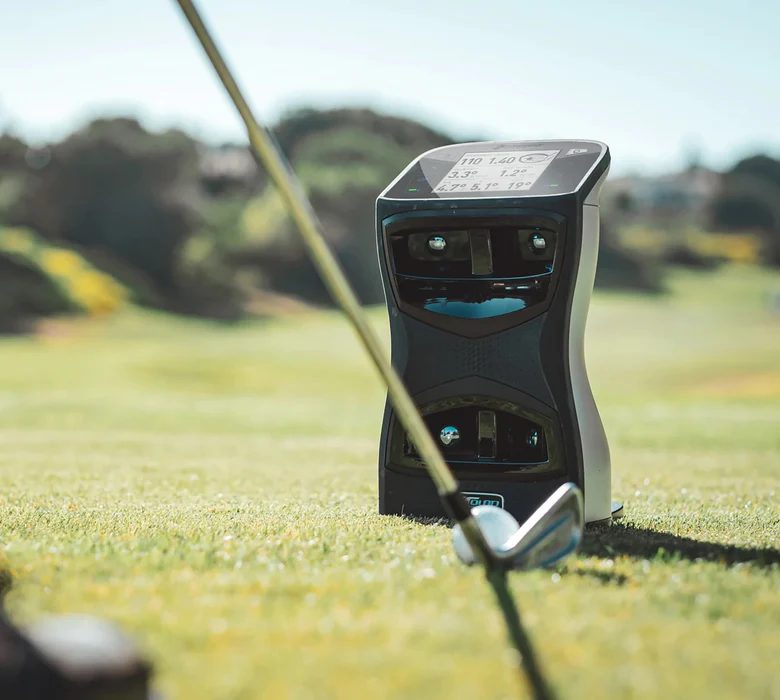
That's why a camera unit sits right next to the ball and takes up almost no room. A Garmin R50 goes about 1½ feet to the side. A SkyTrak+ sits 16 inches away and projects a red dot on the mat so you know where to put the ball. SkyTrak's ST MAX asks for a 10 by 10 foot unobstructed area and that's it.
Worth clearing up a common misconception here: camera units are not indoor-only. Foresight builds its portable units for the range as much as the sim — the GC3 is sold as a launch monitor for indoor and outdoor use, with a screen designed to stay readable in daylight. Bushnell says the same of the Launch Pro: the range, the course, or your garage, take your pick.
If anything, cameras are the more portable technology of the two. They don't need a long room, so they work in places radar can't, and they work outside just as happily.
What they do need is a clear view. Direct sun straight onto the lens can cause problems, and a reflective surface in shot can confuse them. That's a positioning question, not an indoor-versus-outdoor one.
Examples: Foresight GC3 and GCQuad, Bushnell Launch Pro, Garmin Approach R50, SkyTrak+ and ST MAX, Uneekor EYE MINI.
Overhead: cameras, out of the way
Same camera technology, mounted on the ceiling looking down. Nothing on the floor, nothing behind you, nothing to kick.
The catch is that the ceiling becomes your constraint, and the windows are narrow.
| Unit | Mount height above the hitting surface | Where it sits |
|---|---|---|
| TrackMan iO | 8 ft 10 in – 10 ft 6 in, across three versions | Above, ceiling or drop pole |
| Uneekor EYE XO, XO2 | 9 – 10 ft | 3 ft 6 in in front of the tee |
| Uneekor EYE XR | 9 – 10 ft | 3 ft 6 in behind the tee |
| Foresight Falcon, GCHawk | 9 ft 6 in – 10 ft 6 in | Above |
Every one of them lands in roughly the same nine-to-ten-and-a-half-foot band. If your ceiling is under nine feet, overhead is off the table — not "tight", off the table.
These are hard limits in both directions, which surprises people. Foresight answers the question directly in their own setup guide: can you mount a Falcon or GCHawk higher than 10 feet 6 inches? No. Going too high narrows the detection zone and the tracking gets unreliable. TrackMan sells the iO in Low, Mid and High versions precisely because the margin is that tight, and Uneekor says it can't guarantee accuracy outside 9 to 10 feet — if your ceiling is too tall you need a drop mount to bring the unit down into range.
Overhead is the cleanest setup in a room that suits it, and impossible in a room that doesn't. There's no adjusting your way around it.
Examples: TrackMan iO, Uneekor EYE XO and XO2, Foresight GCHawk and Falcon, ProTee VX.
Why this matters before you look at a single price
A Garmin R10 and a Garmin R50 come from the same company and sell to the same golfer. The R10 needs 6 to 8 feet behind you plus 8 feet to the net. The R50 needs 18 inches to the side.
Same brand. Same buyer. Completely different room.
If you take one thing from this page, take that. Work out where a unit sits before you fall in love with its numbers.
The comparison chart
Grouped by where the unit sits, because that's what decides whether it fits your room. Within each group, most expensive first.
Blank cells mean the manufacturer doesn't publish that figure. We've left them blank rather than guess — a wrong ceiling height costs somebody a build.
Behind the ball — radar
| Model | Used value | Behind the ball | Room depth | Ball markings | Screen |
|---|---|---|---|---|---|
| TrackMan 4 | $9,450–11,475 | 6–9½ ft 7 ft best | 17 ft min 20 ft best | RCT for indoor spin | None |
| FlightScope X3 | $3,150–3,825 | — | — | Stickers or RCT | None |
| Full Swing KIT | $1,645–2,000 | 8–10 ft indoor 10 ft outdoor | 16–20 ft | RCT validated | ✓ 5.3″ OLED |
| FlightScope Mevo+ | $545–665 | 7–9 ft | ~17–22 ft | Stickers or RCT | None |
| FlightScope Mevo Gen2 | — | 8 ft | ~16 ft | Stickers or RCT | None |
| Rapsodo MLM2PRO | $350–425 | 6½–8½ ft | + net distance | RPT required | None |
| Garmin Approach R10 | $265–320 | 6–8 ft | ~14 ft | RCT recommended | None |
| Rapsodo MLM | $105–128 | — | — | — | None |
| Shot Scope LM1 | — | 4–5 ft 6–8 ft speed training | — | None | ✓ |
A dash means the manufacturer doesn’t publish that figure, or we don’t have enough sales of that model to quote a price. Where the answer is genuinely "no", it says so.
No ceiling column here on purpose. A radar unit sits on the floor looking downrange, so the ceiling isn’t its constraint — it’s yours. Any indoor setup needs enough height to swing a driver and let a lofted shot reach the screen, whatever technology you use. TrackMan is the only brand that publishes a figure, because they document the whole room rather than just the sensor: 9 feet minimum, 11 for comfort. Treat that as the general indoor rule. Ceiling height only becomes a sensor requirement with overhead units, below.
Beside the ball — cameras
| Model | Used value | Position | Club markings | Screen |
|---|---|---|---|---|
| Foresight GCQuad | $6,390–7,760 | About 22 in to the side | Markers required. 4 = full set, 1 = reduced | ✓ |
| Foresight GC3 / GC3s | $3,430–4,165 | Beside the ball | Required for club data | ✓ |
| Garmin Approach R50 | $2,800–3,400 | 1½ ft to the side level with the mat | Sticker required (not putting) | ✓ |
| Uneekor EYE MINI | $1,344–1,632 | Beside the ball | Stickers required | ✓ E-Ink |
| Bushnell Launch Pro | $1,260–1,530 | Beside the ball keep it at mat level | Required for club data | ✓ |
| Bushnell Launch Pro Indoor (LPi) | — | Beside the ball | Required for club data | None — indoor only |
| SkyTrak+ ST+ | $800–970 | 16 in to the side red dot marks the ball | — | ✓ |
| SkyTrak ST MAX | — | Beside the ball | — | ✓ |
| SkyTrak Original | $370–450 | Beside the ball | — | ✓ |
Overhead and rear-mounted
| Model | Mount height | Position | Tee to screen | Club markings |
|---|---|---|---|---|
| Foresight Falcon / GCHawk | 9½ ft min 10–10½ ft best 10½ ft hard max | 3 ft in front of the ball | — | Required for club data |
| TrackMan iO | 8 ft 10 in – 10 ft 6 in three versions | Above | 8 ft 2 in min 10 ft best | None |
| Uneekor EYE XO / XO2 | 9–10 ft | 3 ft 6 in in front of tee | 10 ft min 12 ft best | 2 stickers — none read if the ball covers one |
| Uneekor EYE XR | 9–10 ft drop mount if outside | 3 ft 6 in behind tee | As above | None — AI club tracking |
Software, transfer fees and simulator compatibility
This is the table to read before buying anything used.
| Model | Software cost | Transfer fee | Works without transfer | GSPro |
|---|---|---|---|---|
| Foresight GCQuad, QuadMAX, Falcon, GCHawk | FSX subscription Silver $199 · Gold $499 | $1,000 | Screened models yes Overhead no | Yes — needs FSX |
| Foresight GC3 / GC3s | Silver $199 · Gold $499 per year | $500 | Yes | Yes — needs FSX |
| Bushnell Launch Pro / LPi | Silver $199 (incl. club data) Gold $499 per year | $250 | LP yes · LPi no | Yes — Gold only |
| TrackMan 4 / iO | Two annual subscriptions prices not published | Varies by region | Outdoor practice via phone | Unofficial workaround |
| Uneekor EYE series | Player $0 · Pro $199 Champion $399 · Ultimate $599 per unit, per year | $100 | EYE MINI yes Others no | Yes |
| Garmin R10 / R50 | $9.99 per month or $99.99 per year | None | Yes | Yes |
| Rapsodo MLM2PRO | $199.99 per year or $599.99 once, lifetime | None | Yes | Yes |
| FlightScope Mevo+ / Gen2 | $0 — E6 courses included outright optional E6 Basic $300 / Expanded $600 | None | Yes | Yes |
| SkyTrak | Four annual tiers prices vary — check current | None — free detach | Yes | Unofficial workaround |
| Full Swing KIT | $0 — all 16 data points, no unlock | None | Yes | Yes |
| Shot Scope LM1 | None | None | Yes | — |
Across every brand here, bundled software stays with the original owner. Nothing you see included in a new-unit listing comes with a used one.
A couple of things that catch people out. Uneekor bills per unit, so a second bay costs a second subscription. And SkyTrak's two Core tiers are named "Foresight" and "TrackMan" — those are course packs, not compatibility with those brands' hardware, which is a genuinely confusing bit of naming.
TrackMan doesn't publish its subscription pricing anywhere, so we've left that one blank rather than guess at it.
The software can cost more than the launch monitor
Put the subscription next to what the unit is actually worth used and some of these stop making sense.
| Unit | What it's worth used | Top-tier software, one year |
|---|---|---|
| SkyTrak Original | $370–450 | Top tier runs to several hundred a year |
| Rapsodo MLM2PRO | $350–425 | $199.99, or $599.99 once for life |
| Garmin Approach R10 | $265–320 | $9.99 per month or $99.99 per year |
| FlightScope Mevo+ | $545–665 | Nothing — courses included outright |
A used SkyTrak Original costs less than a single year of SkyTrak's own top membership. You don't have to buy that tier, and the cheaper ones are perfectly usable — but it's worth knowing before you treat the purchase price as the price.
It also puts the Full Swing KIT and the Mevo+ in a different light. Both charge nothing recurring, which never shows up in a comparison based on sticker price alone.
Will it actually fit? The room math nobody publishes
Manufacturers publish minimums one at a time. Minimum ceiling. Minimum ball flight. They rarely add them up for you, and the sum is the number you actually need.
Here's the arithmetic:
Space behind the ball + ball flight to the screen + a little room behind the screen = the room depth you need
Run TrackMan 4 through it. Seven feet behind the ball, 12 feet of flight, one foot behind the screen — those are TrackMan's own optimal numbers, and they come to 20 feet.
You can build it in 17 by dropping to their minimums, 6 feet behind and 10 of flight. It'll work. But you're at the bottom of the range in both directions, and that's the setup people end up unhappy with.
Plan for 20. Measure your room before you shop, not after.
The two-car garage
Most two-car garages are around 20 feet deep, which is why Bushnell can say most of them work. Depth usually isn't your problem.
Ceiling height is. Plenty of garages come in at 8 feet, and once you allow for a garage door track you may have less than that. TrackMan 4 wants 9 feet minimum and 11 to be happy. Uneekor needs 9 to 10 feet of clear mounting height above the mat.
Measure to the lowest thing in your swing path, not to the highest point of the ceiling. The door track, the light fitting, the opener — whichever hangs down furthest is your real ceiling.
The basement
Basements are where simulator plans go to die, and it's almost always the ceiling.
A typical finished basement runs 7½ to 8 feet. That rules out TrackMan 4 at 9 feet minimum. It rules out the overhead units, which need 9 to 10 feet of mount height before you even start. Even TrackMan's shortest iO version, the Low, wants 8 feet 10 inches.
If your basement is under about 8½ feet, you're looking at a camera unit beside the ball. A SkyTrak, a Launch Pro, a GC3, a Garmin R50. Those don't care about your ceiling beyond whether you can swing without hitting it, and that's a question about your height and your driver, not about the launch monitor.
That's a genuinely useful answer, and it's the opposite of what a price-ordered list would tell you.
The spare bedroom
Say you've got 12 feet of depth. Radar is out. The R10's 14-foot minimum doesn't fit and TrackMan's 17 doesn't come close.
A camera unit beside the ball will fit — ST MAX asks for 10 by 10. You'll want a good net and you should be honest with yourself about swinging a driver in a bedroom, but the launch monitor isn't the thing stopping you.
Don't forget width, or which way you swing
Depth gets all the attention. Width matters too, especially for a unit that sits beside the ball.
If the unit lives to your side, a left-handed golfer and a right-handed golfer generally can't share a setup without moving it. Uneekor is the one manufacturer we found that addresses this head on — their units handle both without shifting the hardware, as long as the room is wide enough. Most others stay quiet on it.
If two people of different handedness are going to use the room, ask the question before you buy.
Measured or calculated? The most useful question you can ask
Every launch monitor gives you a long list of numbers. Only some of them are things the unit actually saw. The rest are worked out from what it did see.
That distinction doesn't show up on a spec sheet, and it explains most of the price gap in this category.
What's really going on
A radar unit behind you watches the ball fly. It sees ball speed, launch angle and direction directly. It can't see your clubface — there's a golf ball and a lot of air between the unit and the impact. So club path, face angle and face-to-path get calculated from how the ball behaved, plus a model of how clubs generally work.
A camera unit beside the ball, with markers on the clubface, sees the face directly. Those same numbers are measured.
Two spec sheets can both list "club path." One watched it happen. The other worked backwards from the ball.
This isn't a reason to avoid calculated data
A good model gets close, and for most golfers most of the time the calculated number is fine. Plenty of people improve enormously with a unit that infers half its numbers.
The point isn't that calculated is bad. The point is that you should know which is which — especially when a $500 unit and a $15,000 unit appear to give you the same list.
Spin is where the budget units fall down
If you only check one metric before you buy, check how the unit gets spin.
Spin is the hardest thing on the list to measure, and it's the number affordable units are weakest on. Not because the engineering is lazy — because of the physics we just went through. Radar reads spin off the ball's flight, and indoors there isn't enough flight to read. So the unit models it instead.
That's why spin numbers from a budget unit in a garage can look plausible and drift a long way from the truth. It's also why spin matters more than it sounds: your launch monitor uses spin to work out carry, peak height and total distance. A soft spin number quietly bends every distance it shows you.
The Rapsodo MLM2PRO is the exception worth knowing about. It genuinely measures spin at a price where nothing else does — but only with an RPT ball. Use a normal ball and you're back to an estimate. Three RPT balls come in the box, which tells you how the economics work.
The same fix exists further up the range. Titleist's RCT balls put a radar-reflective marker inside the ball so radar units can read spin indoors, and they're validated with TrackMan 4, the Garmin R10, Full Swing KIT, FlightScope X3 and Mevo+, and the Rapsodo MLM.
So the honest summary: if indoor spin accuracy matters to you, either budget for the right balls or budget for a camera unit. Buying a cheap radar unit and hitting range balls into a net indoors will give you spin numbers, but don't build your gapping around them.
Why some units want special balls
This is the same question wearing a different hat.
Radar reads spin off the ball's flight. Indoors there isn't enough flight, so spin gets modelled instead of measured. Titleist's answer is RCT — a radar-reflective marker built into the casing layer of Pro V1, Pro V1x, Left Dash and AVX. Their own claim is the clearest description of the problem you'll find: it lets radar launch monitors "measure, not estimate" spin indoors. They put indoor spin capture above 99%.
Rapsodo goes further. The MLM2PRO needs an RPT ball — Callaway Chrome Tour, Chrome Soft X or Titleist Pro V1 in the RPT version — to show measured spin at all.
And why others want stickers
Camera units have the opposite problem. They can see the ball fine. They struggle to see the clubface.
So they sell you stickers. A Foresight GCQuad needs club markers to give you club data, and the manual is refreshingly blunt about the trade: with markers on, you get clubhead speed, smash factor, attack angle, swing path, face angle, loft and lie — but the hitting zone gets smaller. Take the markers off and the zone grows, but the club data goes away. Four markers gets you the full set; one marker gets you a shorter list.
Uneekor's EYE XO2 uses two stickers on the face, and the manual warns that if your ball covers either one, you get no club data at all.
Garmin's R50 needs a sticker for club data too, though not for putting. The Uneekor EYE MINI comes with stickers and a pair of tweezers to put them on, which tells you how fiddly it can get.
Not all of them, though
Two units read the club without any stickers at all, and if the fiddling bothers you they're worth knowing about.
Uneekor's EYE XR uses dual high-speed cameras and AI club tracking to get club data with nothing on the face. TrackMan's iO states plainly that no markers are required on club or ball.
That's a real quality-of-life difference. Stickers wear out, need replacing when they get dirty, and on a GCQuad they shrink your hitting zone. On a unit you'll use several times a week, "no stickers" is worth more than it sounds on paper.
The short version
Radar units sell you a ball so they can see spin. Most camera units sell you stickers so they can see the club — though the newer ones are starting to manage without.
Neither is a flaw. It's the sensing method showing through. But both are ongoing costs that never appear on the price tag, and both are the difference between a number that was measured and one that was modelled.
Indoors, outdoors, and what actually breaks
"Works indoors and outdoors" is on nearly every box. It's technically true nearly every time and it doesn't tell you much. What matters is what gets worse, and where.
Radar outdoors
This is radar at home. Full ball flight, nothing to model, everything measured. If your golf happens at a range, a radar unit will give you excellent numbers for the money.
Radar indoors
This is where it gets compromised, and spin is the casualty. There isn't enough flight for the unit to read spin properly, so it estimates. Everything downstream of spin — carry, apex, total — inherits that estimate.
An RCT ball fixes it if your unit supports one. Otherwise, treat indoor spin from a radar unit as a ballpark.
Radar into a net
Short flight is the hardest case of all, and it's what most people at home are actually doing. Some units have a specific mode for it — FlightScope's limited flight setting works with 8 feet of ball flight and metallic stickers on the ball. Check for that mode before you buy if a net is your plan.
Cameras outdoors
Works. The thing to manage is the sun. Direct light into the lens is the failure case, so think about which way the unit faces at the time of day you actually practise. Reflective surfaces in view can confuse it too.
Cameras indoors
Also works, and this is where cameras pull ahead — no flight needed, so a short room costs you nothing. Bushnell suggests premium balls for reliable reads. Most camera units want a mat rather than grass, since they need a consistent surface to find the ball on.
Buying one used: what you're actually buying
Here's where a launch monitor is different from a driver. Buy a used driver and you own a driver. Buy a used launch monitor and what you own depends on the screen, the software account, and in some cases a fee you didn't know about.
We buy and sell these, so this section is the one we'd most want a customer to read before they hand money to a stranger on a forum.
First question: does it have a screen?
This decides whether the unit works the moment it arrives.
A unit with its own display is a working launch monitor out of the box. Take it to the range, hit balls, read your numbers. No software, no subscription, no account.
A unit without a screen is inert until you connect software, because there's nowhere for the data to appear.
Foresight's own line makes the point better than we could. The Launch Pro has a screen. The Launch Pro Indoor (LPi) — same family, similar unit — doesn't, and it's indoor-only. Buy the first one used and you can practise with it that afternoon. Buy the second without sorting the software and you have a box.
Screens are less common on radar units, which is worth knowing if the range is where you'll actually use it. Most of them — TrackMan, the Garmin R10, Rapsodo, FlightScope — need a phone or a PC to show you anything. Two don't: the Shot Scope LM1, and the Full Swing KIT, whose 5.3-inch OLED is the largest display on any portable unit here.
| Screen, works standalone | No screen, needs software |
|---|---|
| Foresight GC3, GC3s, GCQuad, QuadMAX Bushnell Launch Pro Uneekor EYE MINI Full Swing KIT Shot Scope LM1 |
Bushnell Launch Pro Indoor (LPi) Foresight GCHawk, Falcon Uneekor EYE XO, XO2, XR |
Second question: is there a transfer fee?
Usually not. This trips people up because the exceptions are at the expensive end, where the numbers are big.
Garmin, Rapsodo, Shot Scope, Square, Full Swing, ProTee, NVISAGE and TruGolf have no transfer step at all. You start your own membership and the device works.
Three brands charge:
| Brand | Fee | What it gets you |
|---|---|---|
| Bushnell Launch Pro and LPi | $250 | Registration in your name, support access, and confirmation the unit isn't reported lost or stolen. Handled by Foresight, not Bushnell. |
| Foresight GC3, GC3s | $500 | |
| Foresight GCQuad, QuadMAX, Falcon, GCHawk | $1,000 | |
| Uneekor EYE series | $100 | The new owner makes a Uneekor account, the seller enters that email on Uneekor's transfer page, and the $100 completes it. |
| TrackMan | Varies by region | Needs TrackMan's approval. Without it you can still use the unit outdoors with your phone — you just can't subscribe to the simulator software. |
One thing worth knowing about the Foresight fee: it's waived if you already own any Foresight launch monitor, or have spent more than the fee with them before. So the same used GCQuad costs one buyer $1,000 to register and another buyer nothing.
Third question: does the software come with it?
Almost never, and this is the expensive surprise.
Across every brand we researched, bundled software doesn't transfer. FlightScope's included E6 courses stay with the original owner. Uneekor's bundled perpetual licences terminate on trade-in. Foresight's position is that FSX licences are not transferable at all.
For Foresight there's an important wrinkle. Officially the software doesn't move. In practice the seller can change the email address on the FSX account and hand it over, and that's been working for years. Foresight's own FAQ half-acknowledges it — they say if login credentials were shared in a sale you may be able to use them, but it isn't supported. Treat it as a real possibility, not a guarantee, and ask the seller directly.
That matters more than it sounds, because of what FSX unlocks.
The bit that catches people: FSX gates GSPro
GSPro is the most popular third-party simulator software, at $250 a year. Foresight units are officially supported.
But you can't just buy GSPro and start playing. Running GSPro on a Foresight unit requires a valid FSX Play or FSX 2020 licence as well. On a Launch Pro it specifically requires the Gold subscription at $499 a year — Silver won't do it.
So buying a used Foresight without the seller's FSX account doesn't just cost you the software. It locks you out of GSPro entirely until you buy in.
Worked example: a used GCQuad
Say you find one at a good price and you want to build an indoor sim with GSPro.
| Item | If you already own a Foresight unit | If this is your first |
|---|---|---|
| Ownership transfer | $0 — waived | $1,000 |
| FSX, if the account doesn't convey | Required before GSPro will run | |
| GSPro subscription | $250 / year | |
| Club markers | Consumable, needed for club data | |
None of that makes a used GCQuad a bad buy. It's a superb launch monitor and it'll still beat buying new. But the sticker price is not the price, and the gap between those two numbers is a four-figure sum for a first-time Foresight owner.
Two questions to ask any seller, in this order: does the FSX account come with it, and have you ever bought anything from Foresight before. The first tells you what you can run. The second tells you what registration will cost.
And one for the Bushnell buyers
Older Launch Pro units are worth more than they look. Foresight's wording is that customers who bought club data before it got bundled into subscriptions keep it permanently. If you find a legacy unit with club data attached, that entitlement stays with it.
On a unit bought today, club data comes with the Silver subscription at $199 a year. Gold at $499 buys third-party access like GSPro, not club data. Without any subscription you get neither club data nor simulation.
What holds its value, and what doesn't
We buy and sell these for a living, so we can answer a question the manufacturers won't: what happens to the price after you own it?
The numbers below come from our own sales over the last six months. They surprised us.
| Model | Replaced by a newer model? | Change over the past year |
|---|---|---|
| SkyTrak Original | Yes, twice — SkyTrak+, then ST MAX | Down 50% |
| FlightScope Mevo+ | Yes — Mevo Gen2 | Down 35% |
| SkyTrak+ ST+ | Yes — ST MAX | Down 25% |
| Garmin Approach R10 | No | Down 6% |
| Foresight GC3, GCQuad, Garmin R50 | No | Flat |
| TrackMan 4 | No | Up |
It's not about price. It's about the product cycle
The obvious explanation is that expensive gear holds value and cheap gear doesn't. That's not what's happening.
Look at the Garmin R10. It sells used for under $400, which makes it cheaper than a second-hand SkyTrak Original. If price were the driver it should be falling fastest of anything on that list. It's down 6%, and that's across sixty sales, so it isn't a fluke.
The difference is that Garmin still sells the R10 as a current product. The SkyTrak Original has been replaced twice.
That's the pattern. Every model that's been superseded is falling hard. Every model that hasn't is flat or rising. Cheaper units get replaced more often, which is why they look like the ones that lose value — but the replacement is doing the work, not the price tag.
Two things make it worse at the budget end. The gap between new and used is small in absolute terms, so a used unit at $500 is competing with a new one at $700 that comes with a warranty. And premium units tend to stay in a smaller, more committed market, where transfer fees and locked software mean they change hands less casually.
What to do with that
If you're buying, the useful question isn't "is this a premium brand?" It's where is this model in its cycle? A unit that's about to be replaced is the fastest-depreciating thing in this category. One with no successor in sight will hold up, whatever it costs.
If you're selling, the moment to move is when the replacement gets announced — not six months later, once everyone has noticed.
What each model is worth used
These are realistic private-sale ranges, based on what we've actually seen these units trade for in the last six months.
They're deliberately lower than what we'd sell the same unit for. That's not false modesty — we come with verified condition, a return path and a business standing behind the sale, and that's worth real money to a buyer. A private sale doesn't have any of it.
| Model | Private-sale range |
|---|---|
| TrackMan 4 | $9,450 – $11,475 |
| Foresight GCQuad | $6,390 – $7,760 |
| Foresight GC3 | $3,430 – $4,165 |
| FlightScope X3 | $3,150 – $3,825 |
| Garmin Approach R50 | $2,800 – $3,400 |
| Full Swing KIT | $1,645 – $2,000 |
| Uneekor EYE MINI LITE | $1,344 – $1,632 |
| Bushnell Launch Pro | $1,260 – $1,530 |
| SkyTrak+ ST+ | $800 – $970 |
| FlightScope Mevo+ | $545 – $665 |
| SkyTrak Original | $370 – $450 |
| Rapsodo MLM2PRO | $350 – $425 |
| Garmin Approach R10 | $265 – $320 |
| Rapsodo MLM | $105 – $128 |
Two of these need a caveat. The Mevo+ swings a long way depending on whether face impact and the pro package are included — check before you agree a price either way. And the Launch Pro is worth more if it's an older unit with club data built in, for the reason covered above.
Anything not on this list, we don't sell often enough to give you an honest number. We'd rather say that than guess.
Thinking of selling? We'll give you a firm number, and you don't have to deal with a stranger on a forum.
Get a quoteShortlists, if you'd rather skip to the answer
Under $1,000
The Garmin R10 is the sensible default. It's cheap, it's still current, it holds its value, and 6 to 8 feet behind the ball is manageable in most garages.
If indoor spin accuracy matters, the Rapsodo MLM2PRO measures it properly — but only with RPT balls, so factor those in. If your room is tight, the Shot Scope LM1 needs less space behind the ball than anything else here.
$1,000 to $3,000
This is where cameras start making sense. A Bushnell Launch Pro sits beside the ball, works indoors and out, has a screen so it's usable on its own, and needs 13 feet of depth rather than twenty.
Watch the subscription: club data comes with Silver at $199 a year, and Gold at $499 is only needed for GSPro and other third-party software.
Over $3,000
Foresight and TrackMan, and the choice is mostly about your room. TrackMan 4 needs 20 feet of depth done properly. A GCQuad sits beside the ball and needs a fraction of that.
If you're building a dedicated room with the ceiling for it, the overhead units get everything off the floor — but check your height first, because nine feet is the floor for all of them.
Common questions
What's the minimum ceiling height for a golf simulator?
Nine feet is the practical floor, and ten is comfortable. Below about eight and a half feet, your only real option is a camera unit beside the ball, since every overhead unit needs at least nine feet of mounting height and radar units like TrackMan 4 want nine feet minimum too.
Measure to the lowest thing in your swing path — the garage door track, the light, the opener — not to the highest point of the ceiling.
Can I use a launch monitor outdoors?
Nearly all of them, yes. Radar units are at their best outdoors because they get a full ball flight to read. Camera units work outside too, despite a common belief otherwise — Foresight and Bushnell both build their portable units for the range. The thing to manage outdoors is direct sun on the camera lens.
Do I need special golf balls?
For a radar unit indoors, they help a lot. Titleist RCT balls let radar measure spin rather than estimate it in a short room. The Rapsodo MLM2PRO goes further and needs an RPT ball to show measured spin at all.
Camera units don't need special balls, though Bushnell recommends premium ones for reliable reads.
Do I have to put stickers on my clubs?
On most camera units, yes, if you want club data. Foresight uses markers, Uneekor's EYE MINI and XO2 use stickers, and Garmin's R50 needs one too.
Two exceptions worth knowing: the Uneekor EYE XR and the TrackMan iO both read the club without anything on the face.
Can I buy a used launch monitor and just use it?
Depends entirely on whether it has a screen. A GC3, GCQuad, Launch Pro or Uneekor EYE MINI works out of the box at the range. A Launch Pro Indoor (LPi), GCHawk or EYE XO needs software before it does anything.
Check the transfer fee too. Most brands have none, but Foresight charges $250 to $1,000 depending on model, and Uneekor charges $100.
Does the software come with a used unit?
Usually not. Across every brand we've looked at, bundled software stays with the original owner. With Foresight in particular, ask the seller whether the FSX account comes with it — without it you can't run GSPro at all.
Which launch monitors work with GSPro?
Officially: Foresight, Bushnell, Uneekor, FlightScope, Garmin, Rapsodo, Full Swing, ProTee and Square. TrackMan and SkyTrak aren't official partners, though both can be made to work through community-built connectors that nobody supports.
One warning if you're buying a used SkyTrak specifically to run GSPro. SkyTrak appears to have stepped back from supporting new third-party connections in favour of their own course software, and owners who already had it working report keeping it. Whether a unit you buy today will connect is a question worth putting to SkyTrak before you hand over money, not after.
On a Foresight unit you also need an FSX licence on top of GSPro, and on a Launch Pro that means the Gold subscription.