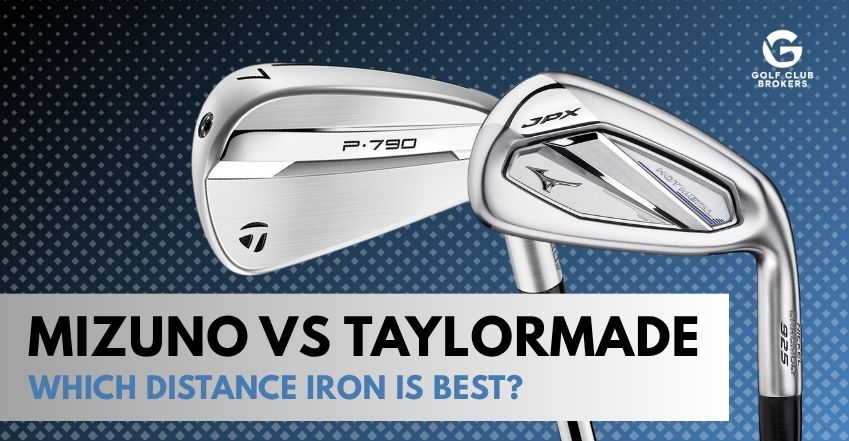
Mizuno JPX 925 Forged vs TaylorMade P790: Which Players' Distance Iron Is Right for You?
Two iron sets land on the trade-in counter at the GCB shop in a single week. Same week. Both 7-irons. One is a Mizuno JPX 925 Forged. One is a TaylorMade P790. Both are clean. Both have current-spec shafts. Both belong to players who upgraded to current models.
Here's the question we get asked more than almost any other in our category: which one of these should I buy?
There's no single answer. The P790 and the JPX 925 Forged both compete in golf's most popular iron category — players' distance — and they each excel at different things. The P790 is the category benchmark for raw ball speed and forgiveness. The JPX 925 Forged is the closest any iron has ever come to matching the P790's performance while keeping that signature Mizuno feel. They're more alike than they used to be. They're also still meaningfully different.
This guide is the honest, side-by-side comparison from a shop that handles both iron sets every week. We'll cover the engineering, the feel, the forgiveness, and — most importantly — which one fits which player. No brand bias. No marketing spin. Just the answer to that one question we get asked every single week.
Quick Answer: Both irons are exceptional players' distance options for 8-15 handicap golfers. The TaylorMade P790 wins on raw ball speed, sweet spot size (24% larger in the 2025 model), and forgiveness — it's the category benchmark. The Mizuno JPX 925 Forged wins on feel, workability, and turf interaction — it's the closest any iron has come to matching P790 performance while keeping Mizuno's signature softness. Pick the P790 if you want maximum distance and forgiveness; pick the JPX 925 Forged if you value feel, shot-shaping ability, and refined turf interaction. Both hold strong resale value on the used market.
The Players' Distance Category: What's at Stake
Players' distance irons sit in the most competitive iron category in golf. The premise: combine the compact, clean shaping of a player's iron with the hollow-body construction, multi-material engineering, and tour-quality face technology that delivers distance and forgiveness usually reserved for game-improvement irons. Done right, you get a single iron that can suit handicaps from low single digits to mid-teens — broader player coverage than any other category.
Done poorly, players' distance irons become a compromise that doesn't excel at anything. Done well, they become the most popular irons in the bag for amateur golfers who've outgrown game-improvement but aren't ready for true blades.
The TaylorMade P790 has been the runaway category leader since its 2017 debut. The Mizuno JPX 925 Forged is the closest any competitor has come to matching it while bringing something genuinely different to the table. For more on this category, see our best irons for mid-handicappers 2026 guide and our forged vs cast irons comparison.
The TaylorMade P790: The Category Benchmark
The P790 has dominated the players' distance category for years for one fundamental reason — TaylorMade got the formula right early and has refined it generation after generation. The 2025 P790 is the seventh iteration and arguably the best the line has ever been.
Construction
The P790's defining feature is its hollow-body forged construction. The forged 4340M face material — new for 2025 — is 20% stronger than the previous face, which let TaylorMade thin it out for more ball speed and a larger active hitting area. The hollow interior is filled with SpeedFoam Air, a low-density polymer that supports the thin face without dampening feel as harshly as earlier SpeedFoam formulations.
Internal weighting uses up to 40 grams of tungsten, strategically positioned via TaylorMade's FLTD CG (Floating Tungsten Center of Gravity) system. Long irons (4-iron through 7-iron) have CG positioned low and back for higher launch and forgiveness. Short irons (8-iron through pitching wedge) have CG progressively higher for better trajectory control and spin into greens. The 4-iron through 7-iron also feature the Thru-Slot Speed Pocket — a cutout in the sole that lets the face flex more on low-face strikes (where most mishits happen).
What the 2025 Refresh Changed
The 24% larger sweet spot is the headline number. The new 4340M face material is 20% stronger than the previous, which let TaylorMade engineers thin the face without sacrificing durability. The result is a meaningfully larger active hitting area — measurable in launch monitor data on off-center strikes.
The 2025 P790 is also the most stable P790 ever made. Strategic tungsten repositioning and CG management produced an iron that twists less on off-center hits than any previous version. For amateur golfers — who miss the center of the face far more often than tour pros — that stability is a real win.
Feel and Sound
Honest take: the P790 doesn't feel like a traditional forged iron. The hollow body and SpeedFoam filling create a feel that some players describe as muted or muffled — not bad, just different from a pure forged blade. Tour players who switch to the P790 from one-piece forged irons often need a few rounds to adjust to the feel. Many players love it once they do. Some never warm up to it.
That's the trade-off with any hollow-body iron. You're getting forged-quality manufacturing (TaylorMade forges the face from premium carbon steel) but the hollow interior changes the acoustic and tactile feedback compared to a one-piece forged design. For the in-family alternative, see our TaylorMade P770 vs P790 comparison.
The Mizuno JPX 925 Forged: The Feel Specialist
Mizuno has been making forged irons since 1933 and has built one of golf's most loyal followings on a single attribute — feel. The 1025E Pure Select Mild Carbon Steel they've used in their forged blades for decades produces an impact sensation other manufacturers chase but rarely match.
The challenge for Mizuno in the players' distance category was simple: how do you build a hollow-body, multi-material iron that still feels like a Mizuno? The JPX 925 Forged is the strongest answer they've produced.
Construction
Mizuno took a smart approach with the JPX 925 Forged — they used different materials in different parts of the set:
- Long irons (4-iron through 7-iron): Chromoly 4120 steel. Higher tensile strength than carbon steel. Allows thinner face geometry for more ball speed and a larger active hitting area in the irons where amateurs need help.
- Short irons (8-iron through gap wedge): 1025E Pure Select Mild Carbon Steel — the classic Mizuno material. Maximum feel and feedback in the scoring clubs where shot-shaping and precise contact matter most.
- Tungsten (4-iron through 7-iron): 20g toe weight for optimal CG placement, pulling mass low and to the toe to improve launch and stability on toe mishits.
The result: long irons that perform like a high-tech multi-material design, short irons that feel like classic Mizuno forged. Best of both worlds when it works. The transition between the two materials is engineered to be acoustically and tactilely consistent, so the player doesn't feel a dramatic difference moving through the set.
CORTECH Design and the Contour Ellipse Face
Mizuno's CORTECH Design with the Contour Ellipse Face is the JPX 925 Forged's headline tech. Variable face thickness distributes the high-performance zones from the low heel to the high toe — exactly where most amateur golfers actually mishit. Combined with Mizuno's new hydraulic forging process (which the brand calls "bang-squish-squeeze"), face thickness can be varied more precisely than traditional forging allowed.
This is meaningful because most variable-thickness faces concentrate the thin zones around the center. The Contour Ellipse Face extends performance into areas of the face amateurs actually strike, which translates to better real-world performance on mishits.
Triple-Cut Sole Technology
One of the most underrated features on the JPX 925 Forged is its triple-cut sole. The leading edge is gently bevelled for clean entry into the turf. The mid-sole is shaped for smooth glide. The trailing edge is hard-cut for clean exit. The result is exceptional turf interaction — even for players with steeper attack angles who tend to dig at the ball.
This matters more than most golfers realize. Turf interaction is one of the biggest contributors to inconsistent iron play, and it's an area where Mizuno consistently outperforms competitors. The JPX 925 Forged is no exception.
Feel and Sound
Mizuno worked specifically on tuning the vibration frequencies that produce the signature Mizuno feel — and they succeeded. The JPX 925 Forged retains the soft-but-responsive impact sensation that Mizuno loyalists expect, even with the hollow-body construction. Reviewers consistently describe the feel as "the closest a hollow-body iron has come to matching one-piece forged."
Direct comparison: where the P790 feels muted, the JPX 925 Forged feels alive. Where the P790 sounds dull at impact, the JPX 925 Forged produces the soft "thud" Mizuno fans recognize immediately. For players who value feedback on every shot, this difference is real. For more on Mizuno's history and full iron lineup, see our Mizuno brand spotlight.
Side-by-Side: The P790 vs JPX 925 Forged
| Spec / Feature | TaylorMade P790 (2025) | Mizuno JPX 925 Forged |
|---|---|---|
| Construction | Hollow body, forged 4340M face | Multi-material forged hollow body |
| Long-iron material | 4340M steel + SpeedFoam Air | Chromoly 4120 |
| Short-iron material | 4340M steel + SpeedFoam Air | 1025E Pure Select Mild Carbon Steel |
| Face technology | 20% stronger 4340M face | Contour Ellipse Face (CORTECH) |
| Internal weighting | Up to 40g tungsten, FLTD CG | 20g toe tungsten in 4-7 irons |
| Sweet spot vs predecessor | 24% larger | Refined evolution |
| Shaping | Angular, slightly larger profile | Compact, rounded, classic Mizuno |
| Sole design | Standard sole with Speed Pocket | Triple-cut sole (turf interaction) |
| Feel | Muted, softer, hollow | Alive, responsive, classic Mizuno |
| Sound | Dull, muffled | Soft thud, more feedback |
| Best for | Distance + forgiveness seekers | Feel + workability players |
| Used-market depth | Excellent (most-traded iron at GCB) | Strong (growing) |
Direct reviewer quote on the feel difference (from Bunkered's head-to-head test): "The P790 has a larger hollow body design, which is a little duller and softer in feel. The Mizuno JPX 925 Forged has that classic Mizuno feel but has just that touch more responsiveness, which is great if you like shape shots."
Which Iron Should You Choose? Matching Each to Player Type
Choose the TaylorMade P790 If...
- You prioritize raw distance and forgiveness over feel
- You're a 10-18 handicap who consistently misses the center of the face
- You want the largest sweet spot in the players' distance category
- You're transitioning from game-improvement irons and want minimal adjustment
- You like a slightly larger, more angular head shape at address
- You play in conditions where consistent distance gapping matters more than shot shaping
The P790 is the safe, high-performance pick for most amateur golfers. Forgiveness and distance are both at the top of the category, and the iron is consistent across the entire set. Brand recognition is also higher, which translates to stronger resale value on the used market.
Choose the Mizuno JPX 925 Forged If...
- You value feedback and feel as much as distance
- You like to work the ball — draws, fades, half-shots, knockdowns
- You're a 5-15 handicap with solid (but not perfect) ball-striking
- Your turf interaction is inconsistent — the triple-cut sole genuinely helps
- You prefer a more compact, rounded address profile
- You appreciate the legacy and craftsmanship of Mizuno's forging process
The JPX 925 Forged is the iron for players who refuse to accept the muted feel that most hollow-body designs deliver. If you've tried a P790 and walked away thinking "these are great, but they don't feel like real forged irons," the JPX 925 Forged is built specifically for you.
The Honest Compromise: Both Are Excellent
Here's what we tell customers at the shop when they're agonizing over this decision: you cannot make a wrong choice between these two iron sets. Both are top-tier players' distance irons. Both will improve your game versus older equipment. Both hold strong resale value if you decide to switch later. The differences between them are real, but they're nuances — not deal-breakers.
The right answer comes down to which one feels better in your hands and produces better numbers on your launch monitor. If you can hit both during a fitting, do it. Pick the one that produces a better dispersion pattern and more consistent distances. Don't pick based on brand reputation or magazine ratings. Our golf club fitting guide covers the broader fitting process.
Used Market Reality: Where the Smart Money Is
Both the P790 and the JPX 925 Forged are exceptional new — but the used market is where most amateur golfers should actually be shopping. Here's the breakdown of what's available and how each compares.
Used P790 Options
- P790 2023: Same hollow-body SpeedFoam Air construction as the 2025 model, minus the new 4340M face material and the 24% larger sweet spot. Performance is still excellent — most amateurs can't tell the difference on the course. Available used at meaningful discounts.
- P790 2021: Two generations back. Different SpeedFoam formulation (slightly stiffer feel), smaller sweet spot than 2025. Still a tour-quality iron at a strong used-market discount.
- P790 2019: Three generations back, but the original SpeedFoam P790. Lighter overall, more compact profile. Strong choice for players who prefer a slightly smaller head shape.
The P790 is one of the most-traded iron sets at the GCB shop, which means our used inventory rotates quickly across generations. That's a buyer's advantage — you have real selection.
Used JPX Options
- JPX 923 Forged: The direct predecessor to the JPX 925. Same fundamental construction philosophy (multi-material with Chromoly 4120 in long irons), without the new Contour Ellipse Face geometry. Performance is essentially current-gen for most amateurs.
- JPX 923 Hot Metal Pro: Cast players' distance variant from the same generation. Different feel from the Forged version (firmer, more metallic), but excellent ball speed and forgiveness. Often available at deeper discounts than the Forged.
- JPX 921 / 919 Forged: Two and three generations back. Still excellent irons with the signature Mizuno feel. Cult following keeps used prices reasonably strong but below current-gen pricing.
- Older JPX 850 / 900 Forged: Vintage Mizuno players' distance — soft, feel-focused, dramatic discounts on the used market. Performance is dated for tour-level players but still excellent for amateurs.
Mizuno's used market is slightly thinner than TaylorMade's because Mizuno sells fewer units overall in the US. That means used inventory turns over more slowly, but it also means used Mizuno irons depreciate slightly faster than P790s — which translates to better value for buyers. For another underrated forged iron option worth knowing about, see our Wilson brand spotlight.
Don't Forget the Shaft Decision
Here's the part that gets overlooked in most head-to-head comparisons: the iron head matters less than the shaft. A perfectly chosen JPX 925 Forged with the wrong shaft will play worse than a P790 with the right shaft, and vice versa.
Both irons are available in a wide range of stock shaft options:
- Steel shafts: True Temper Dynamic Gold series, Project X LZ, KBS Tour, Nippon Modus 3 — all standard options across both brands.
- Graphite shafts: UST Mamiya Recoil, Mitsubishi MMT, Fujikura Pro, Aerotech SteelFiber — increasingly common stock options for slower swing speeds.
Get fit before buying either iron. The shaft selection affects launch, spin, dispersion, and feel as much as (or more than) the head selection. A 105g stiff steel shaft produces a very different iron than a 60g regular graphite, even in the same iron head.
Key Takeaways: P790 vs JPX 925 Forged
- Both are top-tier players' distance irons for 8-15 handicap golfers. There's no wrong choice between them — only different strengths.
- The P790 wins on distance, sweet spot size, and forgiveness — particularly the 2025 model with the new 4340M face material and 24% larger sweet spot.
- The JPX 925 Forged wins on feel, workability, and turf interaction — retaining the signature Mizuno softness in a hollow-body design.
- The P790 has a slightly larger, more angular head shape; the JPX 925 Forged is more compact and rounded at address.
- Both use multi-material construction. The JPX 925 Forged uses different steels in long vs short irons (Chromoly 4120 in 4-7, 1025E in 8-PW). The P790 uses the same 4340M face material across the set with FLTD CG for progressive performance.
- Used market is where most amateurs should buy. Previous-generation P790s (2023, 2021) and JPX irons (923 Forged, 921, 919) deliver 90-95% of current performance at significantly lower prices.
- Shaft choice matters more than head choice. Get fit before committing to either iron — the shaft affects launch, spin, dispersion, and feel as much as the head.
Frequently Asked Questions: Mizuno JPX vs TaylorMade P790
Is the Mizuno JPX 925 Forged better than the TaylorMade P790?
Neither is categorically better — they win in different areas. The P790 has more raw ball speed, a 24% larger sweet spot (in the 2025 model), and slightly more forgiveness on off-center hits. The JPX 925 Forged has better feel, better workability for shot-shaping, and superior turf interaction thanks to its triple-cut sole. For most amateurs, the choice depends on what you value: distance/forgiveness for the P790, feel/workability for the JPX 925 Forged.
Which iron is more forgiving, P790 or JPX 925 Forged?
The TaylorMade P790 is the more forgiving of the two, particularly the 2025 model. The new 4340M face material allowed engineers to enlarge the active hitting area by 24% versus the previous P790, and up to 40 grams of strategic tungsten weighting plus FLTD CG produce one of the most stable hollow-body designs on the market. The JPX 925 Forged is also genuinely forgiving — among the best in its category — but the P790 is the benchmark for off-center ball speed retention.
Do Mizuno JPX irons feel better than TaylorMade P790s?
For most players, yes. Mizuno specifically tuned the JPX 925 Forged's vibration frequencies to retain the signature Mizuno feel even in a hollow-body construction. The result is more impact feedback, a softer feel, and the classic Mizuno acoustic at impact. The P790 uses SpeedFoam Air to support its thin face, which produces a more muted, hollow feel that many players describe as duller than traditional forged irons. Feel is subjective, but in head-to-head testing, the JPX 925 Forged consistently rates higher.
What handicap level should play the JPX 925 Forged or P790?
Both irons suit handicaps roughly 5-18, with slight differences in ideal fit. The P790 has a wider effective handicap range because of its larger sweet spot and greater forgiveness — strong picks for 8-18 handicap players who want distance and consistency. The JPX 925 Forged plays best for 5-15 handicap players who can take advantage of its workability and feedback. Lower handicaps will appreciate the JPX 925 Forged's classic forged feel. Higher handicaps will benefit more from the P790's larger sweet spot.
Are both irons available with graphite shafts?
Yes. Both the Mizuno JPX 925 Forged and the TaylorMade P790 are available in a wide range of stock graphite options at no upcharge. Common stock graphite shafts include UST Mamiya Recoil, Mitsubishi MMT, Aerotech SteelFiber, and Fujikura Pro series. Senior golfers and slower swing speed players should strongly consider graphite — the weight savings translate into easier launch, less fatigue, and often longer carry distance. Get fit before choosing the shaft.
Do the JPX 925 Forged and P790 hold value on the used market?
Yes, both are among the strongest resale-value iron sets in the used market. The P790 is one of the most-traded iron sets at the Golf Club Brokers shop, with current-generation models holding roughly 60-70% of original retail in good condition. The JPX 925 Forged holds similarly strong value, particularly in the first 18 months after release. Mizuno typically depreciates slightly faster than TaylorMade because of smaller US production volume, but Mizuno's enthusiast following keeps used prices steady once they settle.
Is the older JPX 923 Forged worth buying instead of the 925?
For most amateurs, yes. The JPX 923 Forged uses the same fundamental multi-material construction as the JPX 925 Forged — Chromoly 4120 in long irons, 1025E Pure Select Mild Carbon Steel in short irons. The 925 introduces the new Contour Ellipse Face geometry and refined hydraulic forging process, but the performance differences between generations are small enough that most amateur golfers won't notice them on the course. A used 923 Forged in good condition delivers nearly the same playing experience at a significantly lower price.
How does the P790 compare to the P770?
The P770 is TaylorMade's more compact, more player-oriented sibling to the P790. Smaller head profile, slightly less offset, slightly less forgiveness, but stronger feel and more workability. The P790 is the better choice for distance, forgiveness, and players moving from game-improvement irons. The P770 is better for lower handicaps and players who prioritize shaping over distance. For a deeper comparison, see our P770 vs P790 head-to-head guide.
Related Articles
- TaylorMade P770 vs P790: Which Fits Your Game?
- Mizuno Brand Spotlight
- Best Irons for Mid-Handicappers 2026
- Forged vs Cast Irons: The Honest Comparison
- Golf Club Fitting: The Complete Guide
We keep used inventory of both the TaylorMade P790 and the Mizuno JPX Forged lines in rotation — current generations, previous generations, multiple shaft options, all condition grades. Every iron set is authenticated, hand-inspected, and graded honestly. If you're trying to decide between these two iron sets, we can talk through what your swing actually needs and point you to the best available used option that fits. No upsell, no brand bias. Just honest matchmaking from a team that handles both iron sets every week.